
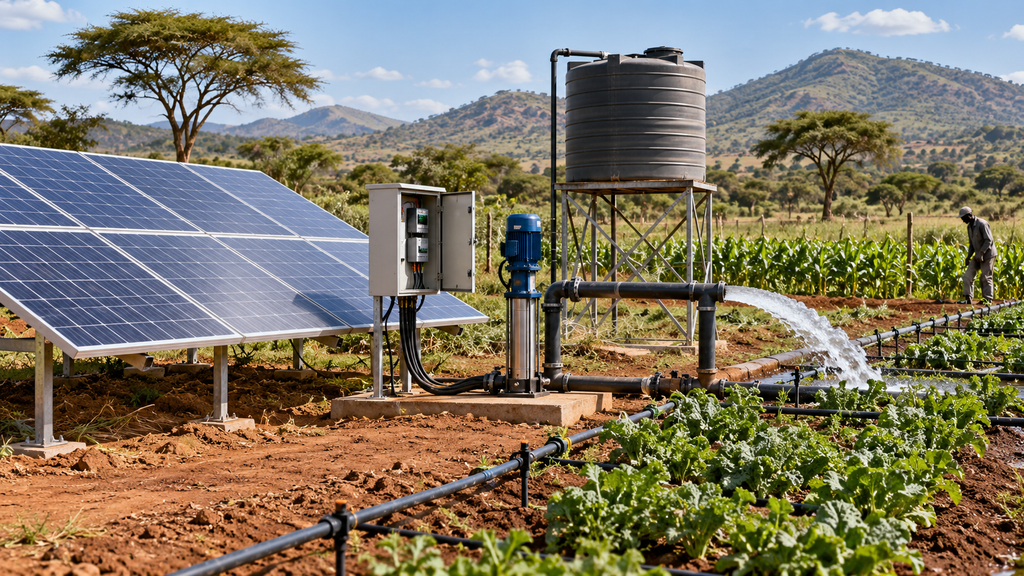
A 7.5kW solar pump inverter can be considered for a Kenyan farm using a compatible three-phase borehole pump. However, selecting the inverter requires more than matching motor power. Borehole yield, total dynamic head, motor current and solar panel voltage must be checked before the system is designed.
Reference Scenario: A Farm with Limited Grid Access
Consider a farm in Kenya that uses a 380V three-phase, 7.5kW submersible pump.
The farmer wants to use solar energy to fill a storage tank during the day and distribute water for irrigation when required.
The main challenge is maintaining a suitable pumping schedule without allowing the borehole to run dry.
Recommended System Configuration
The IDEEI QB100-PV 7.5kW solar pump inverter can be evaluated after confirming the motor’s rated current.
A typical system includes a PV array, solar pump inverter, submersible pump, storage tank and appropriately selected water-level protection.
The PV configuration must be calculated using the solar module’s operating voltage, open-circuit voltage and power rating.
The required daily water volume also determines whether the pump and available solar operating hours can meet the irrigation demand.
Dry-run protection should be configured and tested according to the selected equipment and site conditions.
A practical water-demand worksheet for the Kenya farm
Begin with the volume of water the farm needs, not the inverter label. Record irrigated area, crop type, irrigation method, expected daily water requirement, and the number of days the storage tank should cover. A farmer with several plots should also state whether the plots operate together or in separate irrigation windows. A storage tank makes it possible to pump when sunlight is available and distribute water later, but the tank must be sized around actual consumption and the irrigation layout. Do not assume that a 7.5kW motor will deliver a fixed number of cubic metres per hour at every borehole.
For this reference project, the owner should obtain the pump manufacturer’s performance curve. The curve shows the relationship between flow and pumping head at the intended speed. Total dynamic head combines the water level during pumping, the elevation of the delivery point, pressure needed by the irrigation network, and pipe friction losses. The borehole’s drilled depth is not the same as its dynamic water level. If the water level falls during operation, both the required head and the available borehole yield may change. An installer should compare the desired pumping rate against a suitable borehole yield test rather than relying on a short visual test.
Confirm the three-phase motor before selecting a 7.5kW inverter
Ask for a clear photograph of the complete motor nameplate showing rated power, voltage, current, frequency, and connection information. The proposed QB100-PV 7.5kW unit must be checked against the pump’s rated current and the exact drive variant. Two motors described as 7.5kW may have different rated currents, electrical supply requirements, and installation constraints. A higher-power drive is not a remedy for a pump whose hydraulic performance curve cannot satisfy the required water volume and head.
The installer should record the motor cable length, cable type, borehole headworks, grounding arrangement, and any existing protective equipment. Long motor cables can require additional assessment of voltage drop and drive switching effects. For a submersible motor, follow the motor manufacturer’s recommendations on cable length and output filters. A qualified electrician should assess protective devices, isolation, and earthing before energising the system. The inverter is one element in a larger electrical and hydraulic installation and should not be treated as a complete borehole construction kit.
Build the solar array from the actual module datasheet
A suitable PV module datasheet provides maximum power, operating voltage at maximum power (Vmp), open-circuit voltage (Voc), operating current (Imp), and temperature coefficients. In a simple preliminary calculation, adding identical modules in series increases string voltage, while adding equivalent strings in parallel increases available current. For the proposed inverter, compare the estimated operating string voltage against the specific MPPT operating window and check the highest expected open-circuit voltage against its absolute DC input limit. Allow for the fact that module voltage changes with cell temperature.
Array power should also be considered alongside the hours in which the farm needs water. Poor orientation, partial shading, dust, thermal losses, and seasonal changes in irradiation may reduce usable pumping time. An array that appears adequate from panel nameplate power alone may still leave the storage tank short at particular times of year. Request a site-specific calculation or conservative operating estimate rather than treating daily yield as guaranteed. If there is an existing array, provide its module model and the actual series and parallel wiring before asking the supplier to approve it.
Design dry-run and high-water-level protection
A borehole pumping system should stop or reduce operation when the water source cannot safely sustain pumping. Depending on the approved configuration, a suitably selected sensor, level switch, or compatible pump-monitoring method can be used to protect the pump. A tank-level switch or other approved control can prevent unnecessary pumping once the storage tank reaches the chosen upper level. These devices should be specified in the technical and commercial offer; do not assume that an external sensor or its cable is included simply because the inverter has relevant protection functions.
The installer should test the dry-run response, full-tank stop, restart conditions, and alarm behaviour during commissioning. If the farm uses remote monitoring, verify whether a communication module is available for the exact unit, what local connectivity is needed, and who is responsible for receiving alarms. Remote monitoring does not replace scheduled visual inspection of the wellhead, water leaks, filters, protective devices, and pump cable. If the borehole yields sandy water or frequently loses prime, the hydraulic problem also needs its own remedy.
Install the inverter for the actual Kenyan site conditions
Place the electrical equipment in a location that meets the selected model’s enclosure rating and environmental limits. Shade, suitable ventilation, cable glands, a secure mounting surface, and correctly specified electrical protection are important for long service life. An ordinary control cabinet is not automatically suitable for direct rain, flooding, or prolonged exposure to intense heat. If the proposed drive is an indoor industrial model, the external enclosure and cooling arrangement must be designed separately rather than describing the drive itself as an outdoor IP65 or IP66 product.
The installer should confirm DC polarity and input voltage, AC motor wiring, permitted motor parameters, and all necessary isolating and protective equipment according to the manufacturers’ instructions. After commissioning, record the operating current, approximate water delivery, tank controls, warning messages, and the configured drive parameters. These records make later technical support more effective and help distinguish a drive fault from changing borehole conditions or a damaged pipe.
Compare a direct solar design with a grid-backup requirement
If the farm’s irrigation schedule can be met by daytime pumping and water storage, a solar-first arrangement may be sufficient. If the owner requires additional pumping outside good sunlight hours, discuss the available AC supply and how the chosen inverter is permitted to use it. The buyer should distinguish manual source selection, automatic source switching, and simultaneous solar-plus-AC operation. They are different electrical requirements and must not be assumed interchangeable. The supplier should confirm the actual model, any external switching equipment, and approved wiring before a customer purchases optional components.
Where an AC generator is proposed, provide the generator’s voltage, frequency, and capacity in addition to the pump’s nameplate. An undersized or poorly regulated power source can introduce new operating difficulties even if the inverter itself is properly selected. The project documentation should explain whether the AC source is essential to meeting daily demand or reserved for unusual circumstances. This decision changes the accessory list, capital cost, and commissioning plan.
Four frequently asked questions from farm installers
Can any 7.5kW solar inverter run this borehole pump?
No. The motor’s nominal voltage, rated current, motor type, cabling, and hydraulic duty must match the selected drive and site design. Nominal power is only the first screening step.
How many solar panels should the farm buy?
There is no universal panel count for every 7.5kW pump. The total depends on individual module voltage and power, the chosen inverter’s input limits, site temperature, seasonal irradiation, and daily water demand. The final series-parallel layout needs engineering review.
Does the pump need a battery to supply water at night?
Not necessarily. A correctly sized tank can store water pumped in daylight and deliver it later, depending on the distribution system. If the pump itself must operate at night, its power source requires a separate design.
Is a water-level sensor included with the inverter?
Do not assume so. The supplier should identify standard drive functions, compatible external sensors, cable lengths, and accessories as separate line items where appropriate.
An actionable quotation and shipping checklist
When contacting IDEEI, attach the full motor nameplate, pump model and curve, recent borehole test information, dynamic water level, desired daily water volume, elevation and pipe length to the tank, and the solar module datasheet. State the required quantity, the installation county or town in Kenya, the intended delivery destination, and whether you need sensors, a protective cabinet, a communication module, or an AC backup option. If this is a sample purchase, agree on a technical acceptance plan before ordering additional drives.
Ask the quotation to distinguish the inverter from the pump, PV panels, level sensors, protective equipment, optional modules, packing, international freight, and import-related responsibilities. Confirm the Incoterm, shipping documents, destination, and who arranges customs clearance; a freight price alone does not establish door-to-door delivery or included duties. The scenario in this article illustrates how to approach a Kenyan farm installation and is not a claim that IDEEI has already supplied this particular farm.
Technical Communication and Delivery to Kenya
Before quotation, send the pump nameplate, borehole test information, required head and flow, solar module datasheet and destination.
If this is the first purchase, the installer can request a sample unit for technical evaluation before placing a larger order.
The commercial offer should identify the inverter, optional sensors, packaging, freight and agreed delivery terms separately.
Send your 7.5kW borehole pump specifications to IDEEI for a project-specific selection review.