
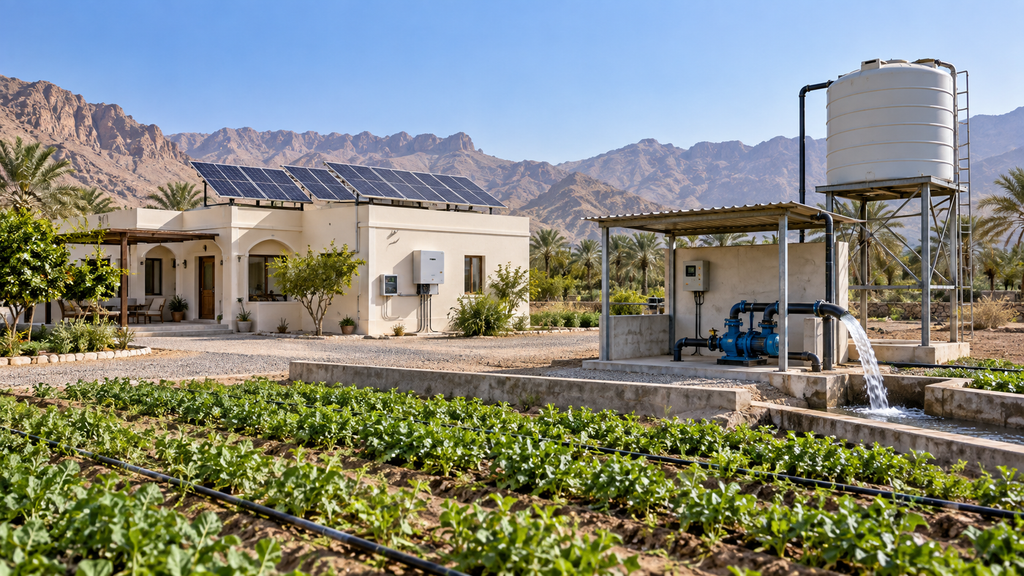
A farm that requires both 220V single-phase power for household equipment and 380V three-phase power for a water pump should first determine whether the two types of loads need to operate at the same time.
An inverter with selectable operating modes is not necessarily capable of supplying both outputs simultaneously.
Reference Scenario: Farmhouse and Water Pump
Consider a farm in Oman with household electrical loads and a three-phase water pump.
The owner wants to use solar energy to supply the farm and is evaluating an 11kW inverter solution.
The main questions are whether the home and pump must operate simultaneously, what current the household loads require, and whether AC backup is necessary.
Comparing Two Operating Configurations
The IDEEI ALLINONE 11kW platform can be evaluated for a compatible project.
Two configurations should be distinguished.
In the regular configuration, the 220V household mode and 380V pump mode require manual selection. The buyer should not assume that both outputs can operate simultaneously.
For a simultaneous-output configuration, the proposed arrangement must be confirmed for the exact model. The specified 220V household output can continuously supply 10A under the stated configuration, with protection when that limit is exceeded.
The system engineer must check the actual pump motor current, household load requirements, solar input and selected operating mode.
Start with the operating duty
For an 11 kW Oman farm with 220 V home loads and a 380 V pump, write down what the equipment must accomplish over a complete working day before choosing a power rating. Record home load schedule, pump current and simultaneous use. A single motor kilowatt figure does not establish duty, performance or the required controls. Ask the owner and site engineer to distinguish measured values from estimates. When an existing machine is being replaced, keep photographs of the nameplate, the previous controller and the wiring diagram. If the system is new, obtain the relevant mechanical or hydraulic design. These inputs allow a supplier to identify assumptions clearly and prevent a quotation from quietly treating an unknown requirement as a confirmed specification.
Electrical compatibility is a model-level decision
Confirm the motor’s rated voltage, current, frequency, speed and connection, then compare each item with the proposed ALLINONE solar inverter model. Check regular manual-mode versus simultaneous-output model; 220 V household output limit of 10 A for the specified simultaneous configuration. The exact model number and its manual matter more than a family name: options can differ in input range, output current, terminals, protection class and accessories. The installation engineer should also document supply quality, earthing, available protection and cable lengths. A motor and drive can display the same nominal kilowatt rating while still being electrically incompatible. Do not approve procurement until the supplier has checked the nameplate against the particular unit offered and listed any required external components.
Build a measurable acceptance test
Turn the project’s objectives into testable acceptance criteria. For an 11 kW Oman farm with 220 V home loads and a 380 V pump, the test should cover normal startup, steady operation, controlled stopping and the consequences of losing a power source or a control signal. Record current, operating frequency, relevant pressure or speed, and any fault indications during a supervised trial. Agree who measures these values and where they will be recorded. A successful bench test at the supplier does not prove performance at the final site because cable runs, ambient conditions and the connected machine differ. A first-unit trial can reveal interface issues before the buyer orders a larger batch.
Plan the controls as a complete system
The control scope needs an explicit wiring and responsibility diagram. Address overload protection and AC/PV connection approval. A drive may expose inputs and software functions, but that does not mean sensors, relays, cabinets or external safety devices are included in the quoted unit price. Agree on the normal operating sequence, each stop condition, reset rules and the response to a broken sensor wire. Decide whether an alarm needs a local indicator or remote notification. Safety devices required by the complete machine or installation should be designed and validated independently by qualified personnel. Documenting these interfaces before shipment reduces costly rewiring on site.
Account for the installation environment
Ask for the installation location, altitude, maximum ambient temperature, dust or moisture exposure, and available ventilation space. Enclosure protection belongs to the exact assembly being sold; an indoor inverter is not automatically suitable for a wet outdoor wall. A sealed cabinet may require a thermal review because a running drive dissipates heat. Cable entries, grounding, surge protection and maintenance access should be drawn on the installation plan. If the site is exposed to salt, flooding or direct sun, specify those hazards rather than relying on a generic description such as outdoor use. Confirm who supplies the cabinet and who certifies its finished protection rating.
Check energy and power-source assumptions
If photovoltaic input is proposed, request module Voc, Vmp, Isc, Imp, power rating and temperature coefficients, as well as the proposed series and parallel arrangement. Check cold-weather open-circuit voltage and hot-module working voltage against the exact drive limits. Compare expected production with the operating hours and demand in the site plan, allowing for shading, wiring losses and seasonal changes. If utility or generator backup is required, obtain its voltage, frequency and capacity and use only a connection method approved for the selected model. Do not infer that two sources can be energized simultaneously because marketing material describes the family as hybrid.
Prepare procurement information
A useful request for quotation should contain the machine nameplate, the site description, quantities, delivery location and the scope expected from IDEEI. Include home load schedule, pump current and simultaneous use. Ask the supplier to itemize the main unit, control accessories, sensors, interface boards, protective devices, cabinet and optional spare parts. If an item will be purchased locally, identify the exact specification and connection responsibility. Request the applicable datasheet, user manual and wiring diagram for the proposed variant. Confirm the agreed commercial term and which party handles freight, import clearance, taxes and inland delivery. This makes quotations from several suppliers genuinely comparable.
Commissioning and maintenance records
Before energizing the equipment, the installer should check insulation, polarity where relevant, protective earth, terminal assignments and mechanical readiness. Save a parameter backup and a dated commissioning record containing the model and serial number. Test each intended protective response with the machine under controlled conditions; record the results instead of assuming the default settings are adequate. Establish a routine for cleaning filters and enclosures, checking terminal condition and reviewing fault history. A remote supplier can troubleshoot much faster when the operator can supply measured currents, photographs and alarm codes. Only qualified personnel should modify safety-related wiring or operate the system during tests.
Questions buyers should settle before ordering
Can the selected rating run the motor? Only a check of motor current, duty and the exact model can answer that.
Does the quotation include a complete installed system? Only if the written scope lists the additional components and work.
Will the proposed configuration perform at the site? That depends on the measured conditions and commissioning results, so use a documented acceptance test.
Can the buyer reuse existing equipment? The interfaces and safety design must be checked individually.
Ask IDEEI for a written compatibility review based on the site documents; do not treat this reference scenario as proof that a project has already been delivered.
Procurement and Technical Confirmation
The buyer should provide the pump nameplate, a household load list, required operating schedule and PV module specifications.
Before quotation, confirm whether the project requires the regular version or the simultaneous-output version.
The quotation should state the exact product configuration, available accessories, output limitations and shipping terms.
Send IDEEI your home-load and pump specifications to confirm the appropriate ALLINONE configuration.